ページ

Aug 14, 2012

Digging sweet potatoes for a test

Most of workers in Japan are having the Buddhism holidays this week and they usually go back to their home town to spend the holidays with their parents relaxing themselves. My family are also staying at my parents' home watching the Olympic games, eating and drinking. But my vegetables don't have the holidays. They need water and care everyday while my summer vegetables like cucumbers and tomatoes are getting weak due to scorching sunlight. I have to pull them out and prepare soil for next autumn vegetables like cabbages, pakchoi and Chinese cabbages.
My sweet potatoes are growing healthy and the extension of their vines shows that. For seeing how big the potoroos are, I digged some of them out. I got 2 sweet potatoes and they are as big as my hand having small roots around them. They are still young and I have to wait for at least a month. I've not cared the sweetpotatoes so much with watering them twice a week since they are so strong that they can grow in harsh environment with less care than other vegetables.

Therefore I don't need go to my gardening plot everyday during the Buddhism holidays thanks to the sweet potatoes.

--from iPad

Aug 6, 2012

Boiling sweet corns

"Sweet corns should be boiled as soon as you've harvested them"

That's what my wife's aunt, my gardening teacher, said me. Harvested corns can loose water faster than we expect. That's why my teacher advised me. Today I harvested 2 fresh sweet corns and followed her advice.

 I pour water and the sweet corns in a deep pan, added some spoonfuls of salt and boiled them for 3 minutes. I used a dish as a weight for pressing the sweet corns to boil the whole part of them.
 Water in corns determines the freshness. So I wrapped them with plastic wrapping sheet and store them in my fridge. They will be served in today's dinner.

Jul 26, 2012

The Sashimi Festival

 My family tripped to Shirahama, Wakayama pref. for enjoying swimming in the beautiful sea, taking a nap on the white-sand beach and having a gorgeous dinner in a local seafood restaurant.

The Shirarahama Beach
  I believe most of Japanese love to eat raw seafood especially Sashimi ( sliced raw seafood ). My family also love so much Sashimi and we visit a local seafood restaurant whenever we visit tourism spots near the ocean. Those restaurants have their own seawater pool for keeping fish and other seafood alive and fresh. We can pick up our favorite fish and the chef cook them into our favorite dish. At this dinner, we selected a Japanese spiny lobster, an abalone and a stripped beakfish for Sashimi and a snapper for a deep-fried fish.

A Japanese spiny lobster, a abalone and a snapper 
A stripped beakfish
 I think some bloggers could recognized yellow flowers besides sashimi. These are edible chrysanthemum, which are used not only for decoration but for condiment. At the bottom left of the sashimi dish, something green can be seen. It's a Wasabi or a  grated Japanese horse radish, the most popular condiment for sashimi in Japan. The spicy taste goes well with raw fish.
Assorted sashimi.
A deep-fried snapper
A Japanese spiny lobster boiled in miso-soup.


Jul 21, 2012

Cracked but juicy fruits

 The rainy season, which gave tons of water to my vegetables and damaged my carrots, has finished and a hot summer with scorching sunshine started. As the sunshine was becoming strong, the growth of my summer vegetables was getting so fast that some of them has become too big while I was absent for a few days. When I visited my garden last time, most of my tomatoes were still young and partially red but today I found most of them became as big as my fist and were cracked. The cracks might be caused by too much water the tomatoes sack up. But it's OK. I will not sell them but enjoy them at home. My tomatoes are cracked but so juicy.
Still my tomato trees have many young fruits so my family have to consume them to secure space for them in my fridge.
Today's harvest:
15 tomatoes
2 egg-plants
5 cucumbers


Only 1 intact tomato among 15 I harvested.
Today's dinner:
Tempura of egg-plants and Manganji chili peppers.

Today's dinner
Fresh tomato salad.


Jul 13, 2012

Today's harvests and my wife's birthday.

 It's been sunny in the last few days during a rainy season, which was the important opportunity to work in my garden. We have to watch the growth speed of summer vegetables like cucumbers since they can grow much faster in this season due to tons of rain and strong sunlight. One of my cucumbers became too big while a few days. Big cucumbers has a thick skin but less water inside so we can't use them for salads. Well, I'll have to pickled it in rice bran.

  The fruits of my black chili have also grown well and I harvested some of them with green peppers. They were moderately size to enjoy their taste so I'll stir-fly them with sliced beef in oyster sauce, which is my favorite recipe.

  My egg-plants' growth is slower than usual with fewer and smaller fruits. I think the slow growth might be caused by consecutive cropping.
 The tomato harvesting season has arrived! I found many tomato fruits have been mature turning red, whose size were as big as my fist. I'm very excited with this good results since I failed to grow bigger and delicious tomatoes many times. The success is due to Less fertilizer. Too much fertilizer could be consumed for their leave's growth not for their fruits. My tomatoes are "Momotaro/桃太郎" which is popular variety in Japan.
 My sweet corncobs were about 15cm/7inches. I've not found any damage by bugs yet.
 Today is my wife's birthday so I rushed to a flower shop after working in my garden and a floral designer made a flower bouquet for my wife.

Flowers, fruits and love for my wife


Jul 4, 2012

Pickling cucumbers in rice bran

 Pickling vegetables is not only a way to make them delicious but to preserve them for longer. As many cucumbers are harvested, I've been eager to make "糠漬け (Nukazuke)", one of the Japanese traditional pickled vegetables in rice bran. When I was a child, my mother or my grandma got tons of rice bran for free from a local rice shop since rice bran was seen as just by-product at that time. Many Japanese households had their own taste of the Nukazuke with adding variety seasonings to rice bran.
 Now we can buy a packed rice bran, which is specialized for the pickled vegetables, mixed with salt, pepper, and other seasonings in local shops and I also tried it.
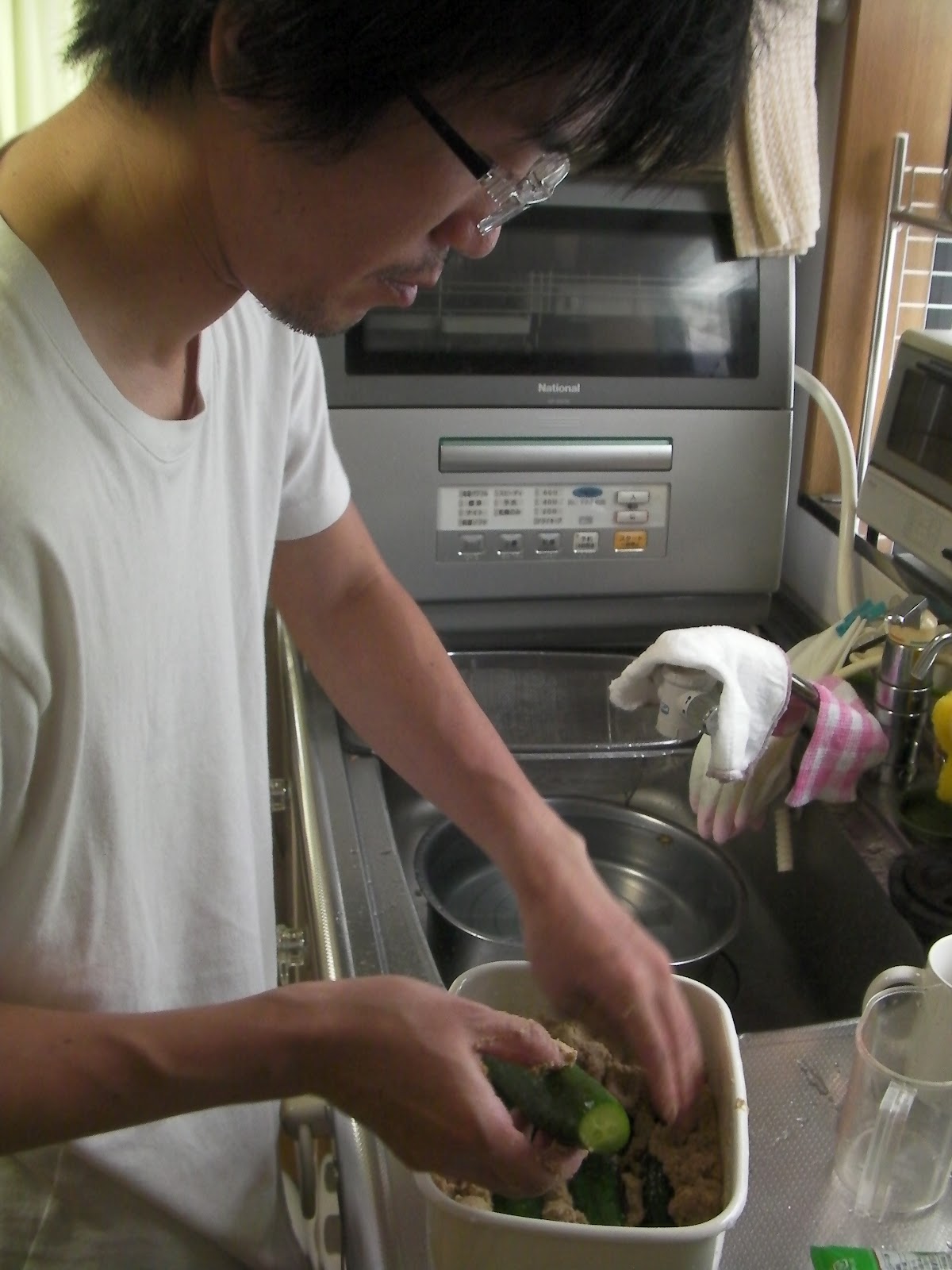
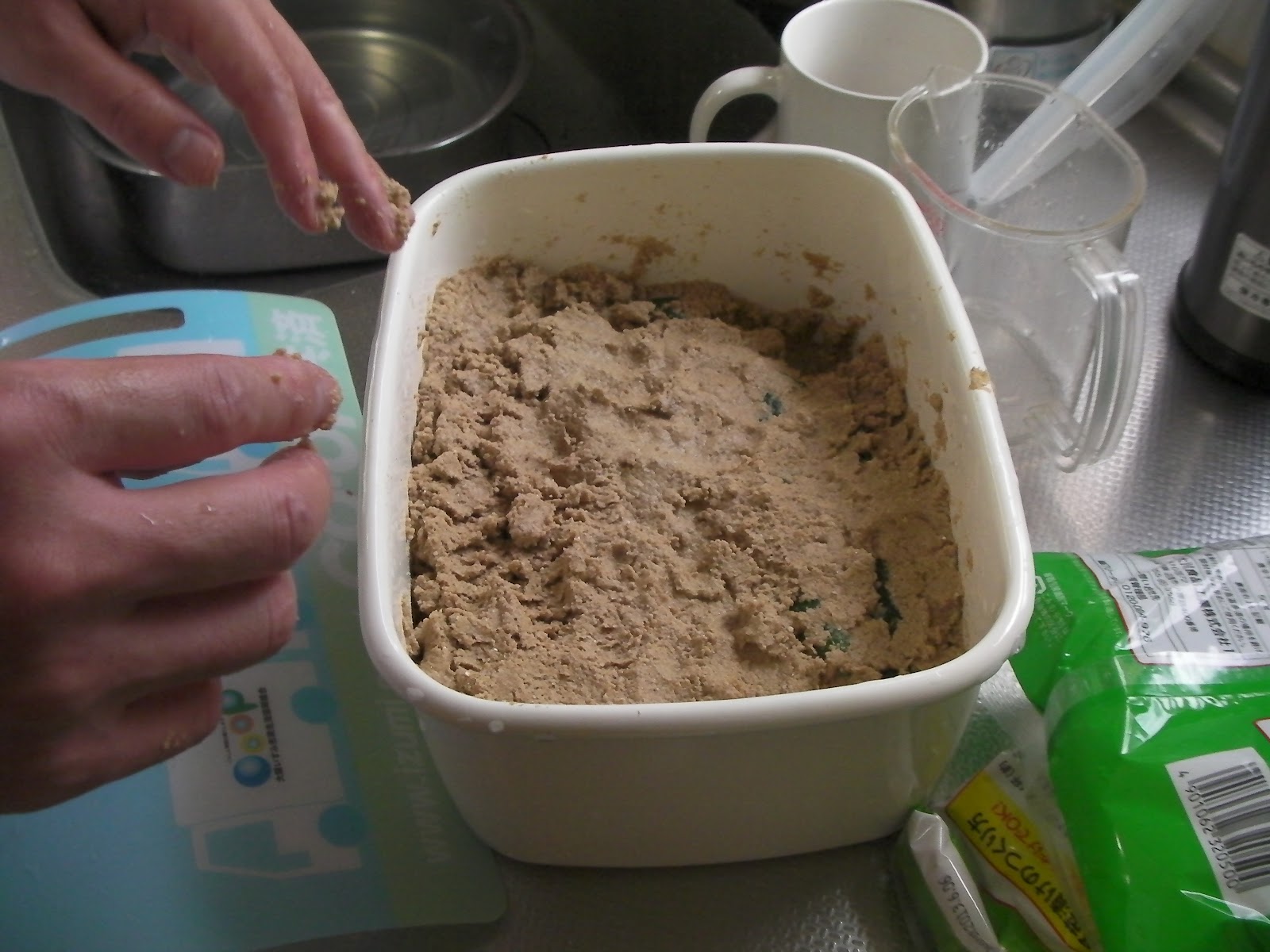
 First, I have to make "a rice bran bed" for cucumber to be pickled there. Add water to the rice bran and mix them up with hands to make it sticky. We have to care amount of water to be added since too much water make the bed too watery.
 When the rice bran bed is completed, put cucumbers onto the bed and,,,,,
cover them fully with the rice bran and keep it in a fridge for a few days.
 After 2 days, I found water coming out of cucumbers in a cup inside the Tupperware which shows the cucumbers had been pickled well and ready to be served. 
  The taste was moderately salty, juicy and very crispy! They go well with steamed rice but my favorite way to enjoy pickled cucumbers is to eat them with cold beer!


Jul 1, 2012

Growth report in the mid rainy season

 Now it's in the middle of a rainy season (Tsuyu/梅雨) in Japan and it has been raining through the whole of the last week in Osaka. As I mentioned in the previous blog, the much rain damaged my carrots. But the rain in this time is also essential for summer vegetables like tomatoes, cucumbers and egg-plants.
  
 My summer vegetables are growing well and I can expect to harvest them in a few weeks.
Young "Momotaro" are still green but growing healthily.
Some of my Momotaros are starting ripen turning red.
My egg-plants are also having fruits while some of
them are fed by bugs.
Shishito peppers

A flower of black chili
My sweet corns are blooming and producing pollens